Cattle Bleeding And Other Desperate Measures

Cattle bleeding during the Great Famine was not uncommon.  Under cover of darkness, the hungry would make their way to the field of a landlord or well-off farmer and locate a likely cow.  A vein would be opened in the animal’s neck and a pint or so of blood drained out into a jar or pail.  The wound would then be sealed with a pin, the hope being that one could return and bleed the animal again.  Cows’ blood was mixed with wild mushrooms, milk, herbs, meal or anything else on hand to make ‘relish cakes’.

The starving also ate chickweed, seaweed, nettles, grass, worms or rats.  Turnips, although traditionally not a human food source as they have limited nutritional value (turnips were stockfeed only), could be made into turnip boxty (cakes) or mashed into ‘champ’.

Although Ireland abounds in rivers, most were privately owned and fishing (poaching) in them illegal.

Famine Fundraising Around the Globe

desertedvillageIt can be argued that the Famine was the first natural disaster (albeit one capitalized upon by London) to spur international fundraising.  A few examples:

Irish in NYC (where they were a quarter of the population) sent home approximately $900,000 in 1847 alone and probably a bit less the year before.  This amount represents private monies between families and is not part of the U.S. relief contributions which totaled in the millions.

Irish serving in the British army as well as ex-pats and natives of Calcutta, India, sent £14,000.

Abraham Lincoln (then a Congressman) donated $10.

The members of New York City’s Shearith Israel synagogue sent $1,000.

The Choctaw Indians of Oklahoma raised $170.

The city of Hackensack, New Jersey, gave 4 boxes of clothing.

The prisoners of New York’s Sing Sing prison sent relief money.

Jewish banker Lionel de Rothschild began fundraising in 1847, receiving donations from  Venezuela, Australia, South Africa, Mexico, Russia and Italy. 15,000 people contributed £400,000.

Contributions came from Turkey, Mexico, Barbados, Bombay and Australia.

Irish American dock workers waived their salaries to load ships bound for Ireland.

American railroads waived fees for relief supplies.

Under pressure from English Quakers, the British Government agreed to cover freight costs of shipments from the U.S.

Queen Victoria gave relief money and wrote fundraising letters, but seems to have done nothing behind the scenes to affect a change in British policy.  Her Famine visit to Ireland (as detailed in another post) was a financial drain on Ireland’s limited resources.

The Irish Catholic Church used its international network to raise huge sums.  Donations flowed in from North America, South America, South Africa, New South Wales, France, Italy and Austria.

The Quakers kept copious notes of monies raised and dispersed.  It is very emotional indeed to read the lists of U.S., Canadian and British cities that contributed food and clothing.   Of course, Boston & New York are in the forefront, but here are a few others: Darien, Savannah, Portland (Maine), New Orleans, Louisville, Georgetown, Rochester, Madison, Utica, Charleston, Cincinnati, Richmond, Newark, Philadelphia, Baltimore.
Grosse Isle, Canada, and The Death of Ellen Keane

Father Bernard McGauran immigrated to Canada in the 1830s.  In 1847,  he led over forty priests who (along with Anglicans) saw to the sick and dying of Grosse Isle.  At least four priests died (a small percentage, probably because they had built up an immunity to typhus working among the poor).  Boarding waiting vessels and seeing to the ill on land, priests might give Last Rites to 50 dying a day.  Like so many, Father McGauran contracted typhus.  Fortunately, he survived. Three orders of nuns also administered to the sick; it is unclear how many of them died.

Four-year-old Ellen Keane of Ireland was the first to die at Grosse Isle, Canada, on May 15th, 1847.   In the weeks to follow, the names of the dead would not be recorded and 6 men would be employed full-time to dig graves.

Grosse Isle was a quarantine station and the port of entry to Quebec.  It lies in the St. Lawrence River and had NO fresh water source.  Astonishingly, it had room for only 150 PATIENTS and boasted a small medical staff.  (As the island became overrun with the ill and dying, Canada released prisoners from the local hospital to help; unfortunately, they stole from and abused the patients.)  In the summer of 1847, Grosse Isle was tasked with handling ALL immigrants bound for Quebec.  Within two weeks of little Ellen’s death, there was a line of 40 ships stretching up river – the queue was well over a mile long.  The hospital could not absorb the sick who were stuffed into sheds, left on the beach, or kept in fetid quarters on grossly overcrowded ships.  Bodies of the dead were removed from ships’ holds with fish hooks and eyewitnesses told of horrific scenes of inhumanity.

It isn’t known how many died on Grosse Isle that summer from starvation, dehydration and disease.  Bodies were piled in mass graves ‘like cord wood’.  Officially, the number is put at about 7,000 but anyone perusing the Canadian Government websites and reading the sanitized version of events there and in ‘official’ records will discount this number.  Scholars put the death toll at more than twice that number.

Among the four doctors who died of typhus was a 60-year-old immigrant named John Benson.  He had been evicted from his Irish home and, upon landing at Grosse Isle, volunteered to help.  He died within the week.

How did this happen?  The influx of 100,000 Irish to Canada in 1847 could have been no surprise to those in Montreal (then Canada’s capital) or London.  Ships sailing from Liverpool took up to two months to reach Canada and inspecting officers knowingly allowed the sick to sail.  Canada was a Crown colony after all, and offloading sick there was akin to the transportation of criminals to Australia.  Passage to Canada was significantly cheaper than to the U.S. because Canadian law allowed the overcrowding of immigrants and did not require that a doctor be on board.  This is why mortality rates on Canada-bound vessels could be anywhere from 20 – 50%.

That Montreal and London (i) knew 100,000 Irish would be emigrating; (ii) did not ensure passenger safety; and, (iii) did not take steps to deal with the consequences in advance is well documented.  Like the Germans a century later, British bureaucrats were meticulous record keepers.

One could argue that the Grosse Isle disaster resulted from incompetence, tangled bureaucracies or the like, but I won’t.  Emigration in sub-human conditions, many times forced by landlords like Dennis Mahon, whose execution is detailed in another post, is a form of mass murder.  It is as simple as that.

The 1849 Visit of Queen Victoria to Ireland

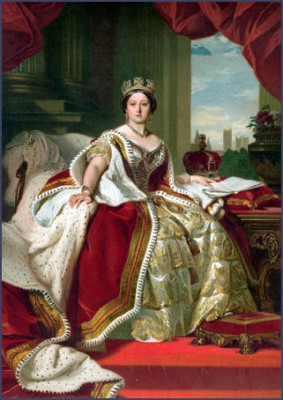
victoria  Four years into the Famine, most of the Poor Unions set up to run Ireland’s workhouses were in dire straits – overwhelmed by the demand for relief and all but bankrupt as the only funding they received was from local landlords (not the British).  Even the Quakers had closed their soup kitchens, concluding that the acute demand for help was beyond their means.  They focused instead on giving seeds for new crops to be planted and lending funds for fisheries or other self-sustaining projects.  Did London step in to the breach?  Only to the tune of 50,000 pounds.

As incredible as it seems, during that horrible year it was decided that Queen Victoria should visit Ireland at the expense of the Irish.  Billed as a ‘non-State’ visit, London refused to foot the bill for the party of 36 (Victoria and Albert decided at the last minute to bring 4 of their children in addition to many servants).  A special carriage lined with ‘royal blue’ silk was built in Ireland to transport the royals.  As Dublin scrambled to make itself presentable, THOUSANDS of pounds were spent sprucing up the areas the royals would see.  The Times of London reported the building of ‘triumphal arches, platforms and devices on all sides’.  Dublin Castle was given ‘a clean face’ and the State Apartments redone.  Gas and electric lighting were introduced to the exterior of Dublin’s public buildings so that the city appeared prosperous and thriving.  How much did this all cost the Irish?  It’s difficult to estimate, but bear in mind that, at that time, a family of 5 could live for a week on half a crown (or 1/8 of a pound); thus, even if the royal tab was only 10,000 pounds, that amount of money could have fed 80,000 Irish families for a week.  As reported in the Evening Mail, ‘if we have funds to spare let them be spent not on illuminations [of the capitol] but on Her Majesty’s starving subjects’.

Victoria’s visit (her first) was hailed a ‘public relations success.’   Why?  How did the Queen choose to spend her time in a land ravaged by Famine and disease?  She attended balls and parties, viewed fire works displays, and made procession through the streets of Cork, Belfast and Dublin.  The only reference she made publicly to the fact that the Irish were starving was in one speech:  “I gladly share with you the hope that the heavy visitation, with which Providence has recently visited large numbers of my people in this country, is passing away.”  By placing blame at Heaven’s gate, the Queen absolved herself and her Government of any responsibility to take action.  In so doing, she echoed the underlying philosophy of London during those fateful years that, because the blight was an act of Nature, man had a right to profit from it, exploit its victims and ignore its consequences.

Did the Queen visit a workhouse?  No.  Did she visit a fever hospital?  No.  Did she visit an orphanage?  No.  Did she visit a farm and see fields lying fallow?  No.

It is noteworthy that the Royal visit was not disrupted by demonstrations or violence.  Why bother?  What impact would a public outcry have made on someone so clueless?  Surely there was no need to draw her attention to the facts since her own newspapers were full of them on a daily basis.


The Castlebar Coffin Fund

Famine victims who worked 10 hours per day on British funded outdoor relief projects (breaking stones, for instance in exchange for food) were not provided with coffins when they died.   As a result, bodies were left to rot on the road where they might be eaten by wild animals or buried in shallow graves wrapped in newspapers, blankets or nothing at all.  Some were simply covered with rocks or left in derelict structures.

Private efforts were made to provide coffins for the dead.  One I’d like to call attention to took place in Castlebar (a town in northern Mayo County) in early 1847.  A scant ten days after the Castlebar Coffin Fund was established, eleven dead had already been provided with coffins.  I came across a letter to the local newspaper, the Tyrawley Herald, dated January 21, 1847 by Father Michael Curley in which he thanks a man from Westport (a town to the south) for his contribution of 1 pound to the Fund.  Father Curley, together with a Methodist minister (Reverend Mr. Atkins) and a Mr. Patrick Walsh, established the Castlebar Coffin Fund.  Father Curley is further credited with taking decisive action when he found out that food distributed to outdoor relief workers in Ballyhane was sickening them.  He obtained a sample of the tainted meal and sent it along to a contact in London who had it examined by corn merchants there.  They concluded that the ‘food’ wasn’t fit for human consumption.*

*Based on reports appearing at the time in the Ballina Chronicle.

The William Smith O’Brien Petitions of 1848-49

Dromoland Castle, County Clare, Ireland, above (now a hotel) was the boyhood home of William Smith O’Brien.

MP and Irish Nationalist William Smith O’Brien supported the repeal of the Act of Union that made pre-Famine Ireland part of the United Kingdom.  He paid dearly for his beliefs and the actions he took to make Ireland free.   Found guilty of treason and condemned to death in 1848, his sentence was commuted to transportation to Tasmania (Australia).  Why?  In the winter of 1848-49, 166 petitions were signed in Ireland (over 75,000 signatures) and England (7,830 signatures) pleading for the British Government to show the jailed leader mercy.  Trinity College, Dublin, has compiled a CD of the signatures and the original  petitions are housed in the Irish National Archives. 

Consider, for a moment, the logistics of gathering those signatures during the darkest days of the Famine.  Consider the rank and file farmers who refused to testify against O’Brien AND who refused to turn him in (he was captured by a British soldier) despite the reward of 500 pounds offered (this amount would have covered the cost of passage to America for well over 100 emigrants).  Consider the risk of putting one’s name to a petition in support of a leader the British so feared  – because of men like O’Brien, Parliament had suspended Habeas Corpus in Ireland and passed a number of anti-sedition acts specifically aimed at squashing demonstrations and appeals for Irish independence.  Consider, too, the options open to William Smith O’Brien – a rich Protestant born into the landed gentry who lived in luxury at Dromoland Castle.   What drove such a man to make his life’s work the pursuit of Catholic Emancipation?  That question must have been asked by many who weren’t able to grasp that O’Brien saw himself first and foremost as an Irishman.

Joseph Bewley: A Friend to those in want

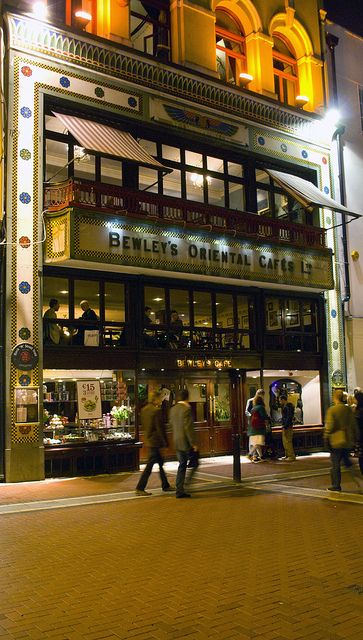
Quaker Joseph Bewley was an Irish tea and coffee merchant – yes, the same Bewley family that established those wonderful cafes in Ireland and broke the monopoly of the East India Company by importing tea directly from China to Ireland.  In 1846, Joseph Bewley helped establish the Friends’ Relief Committee that set up soup kitchens to provide direct, no-strings relief in an organized manner during the Famine.  This was done without British (government) help, being funded privately from a variety of sources.  Joseph Bewley didn’t just talk about aid or raise money, he put his beliefs into practice.  As a result, he was one of 15 Quakers (out of a population of 3,000 in Ireland) who died in the Famine as a direct result of his work with those in need.  The Quakers were noteworthy during the Famine for doing so much given their small numbers and for doing it without an agenda (religious or political).  Help was given to those in need – food in the beginning and then seeds/training later on in the hope that alternative crops to potatoes could be established.

So, when you next stop by Bewley’s (or Java City in the U.S.) remember Joseph Bewley – a man celebrated for his humility and self-sacrifice who paid the ultimate price for his beliefs.

Hedge School vs. National School Emigrants

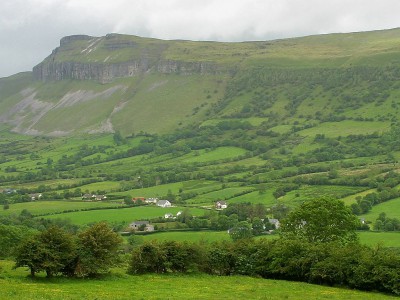
irish lake The 1830’s saw the establishment of national, non-denominational schools in Ireland.  Prior to that, Irish Catholics wishing to be educated had the option of converting to Protestantism or studying in clandestine ‘hedge’ schools.  Such schools were established in the barns and small, out-of-the-way buildings (i.e., behind the hedgerows) of rural communities in circumvention of the Penal Laws (finally repealed in 1829) which forbade Catholic education.  Hedge school students learned Latin, math, history, folklore, poetry, grammar and, of course, the Catechism.  The hedge masters were either learned local men or travelers who’d accept payment in-kind for a few weeks or months of instruction.  Naturally, with the repeal of the Penal Laws and the establishment of the National School system, the need for hedge schools declined.

One wonders whether a hedge school student was better prepared to emigrate than one who’d attended a national school.  In all likelihood, neither student had traveled more than a few miles from home during his life, so the sight of cities like Galway, Limerick or Liverpool would be awesome enough – but New York?  Imagine what new immigrants experienced after stepping off the boat in that harbor.  Were they overwhelmed?  Terrified?  Excited?  Most probably all three.  I suspect, though, that hedge school students who’d learned at the knee of a fellow Catholic versed in the oral tradition and adept at storytelling had the edge over those educated in the structured environment of an English school.

Lord Lucan’s Crowbar Brigade

Ireland’s loss of 1 million to starvation and disease and up to two million to emigration (out of a population of just over 8 million) is the equivalent of America losing 100 million people – a very difficult number to get one’s head around.  That’s why many of the posts on the site look to the individual stories of the Famine’s victims as a tool to make the horror more accessible.  Take, for instance, the evictions carried out by Lord Lucan of Castlebar*.  Lord Lucan (George Bingham) owned approximately 61,000 acres in County Mayo – land he thought better suited for the grazing of cattle than tillage by Catholic tenants.  He is famously quoted as saying he “would not breed paupers to pay priests”.   During a three-week period in 1848 (three years into the Famine), Lord Lucan destroyed 29 homes on his land, evicting the 126 people within (7 of which were noted as being ‘widows’ or women with small children).  29 houses, 126 people.  What became of them?  Lord Lucan’s agents kept records of the evicted – most moved to small sheds, lean-tos or caves in the area, some were able to immigrate to American, some sought relief from the workhouse.  How many died outright or soon after?  How many families were split as a result, with the youngest and strongest emigrating and the weakest and most vulnerable being left behind?  We’ll never know.

Lord Lucan’s dirty work was carried out by his estate agents and what were known as  “crowbar brigades” of desperate men who, for the price of a meal and the chance to survive another day,  wielded crow bars to knock down the homes of their neighbors.  One of these unfortunate souls recounted to the newspaper, The Telegraph, how he worked six days a week ‘pulling down’ sometimes twenty homes a day.   The sick and elderly would be dragged outside, their possessions left to “rot in the open air” while the estate agent responsible had “the curse of those evicted fall on him.”**

Using Irish to subdue or betray other Irish was standard practice by the British during their 800 year subjugation of Ireland.  Doubtless those who took part in the crowbar brigades were hated and ostracized by their own.  The man interviewed by the Telegraph confessed that “I dread …when I am called to go before my God that I belonged to the cursed Crowbar Brigade.”**

* the 3rd Earl of Lucan, not to be confused with the 7th Earl who, facing murder charges, went missing over 37 years ago.  The 3rd Earl is best known as being the commander who ordered the ill-fated charge of the Light Brigade during the Crimean War.

** Interview of events taking place in 1847 given to The Telegraph, August 21, 1880.

Why No Famine-Era Railroads?

Despite Parliamentary findings 10 years earlier recommending construction of a railroad system, by 1846, the second year of the Famine, Ireland had only 123 miles of railroad.  Why?   There was ample land, a great need, Parliamentary support (in the form of votes, not funds) and construction costs were roughly 1/2 those of England.  Most importantly, in a rural society where the transportation of food meant the difference between survival and famine and where the swift deployment of troops could mean the difference between chaos and peace, why, MP George Bentinck argued in the House of Commons, didn’t Ireland have a railroad system?  Why did the country’s economic prosperity rest instead on extensive but unpaved roads, a nascent canal system and a few steamships?

After spending nearly two decades in Parliamentary silence, Lord George Bentinck (son of a Duke) stepped into the spotlight to oppose Prime Minister Peel’s repeal of the Corn Law tariffs.  A protectionist out of principle (he wasn’t opposed to importing cheap corn to feed the starving Irish) Bentinck’s association with the protectionist Benjamin Disraeli gave that man’s anti-Peel movement the blue blood it needed.

After Disraeli and Bentinck helped to force Peel from office (thus giving birth to a new Tory party), Bentinck turned his attention to the Irish Question.  Contemplating the prospect of huge government loans in support of public works programs – the starving weren’t to be given handouts, mind you, but made to build unneeded roads before their bellies could be filled – Bentinck argued that where millions (of pounds) were to be expended by the state, something more advantageous to the community should accrue than the temporary subsistence of the multitude (see Disraeli’s biography of Lord George).  Pointing to the advantages reaped by industrialized Britain in the mid 19th Century, Bentinck posited that the quickest way to weather the Famine and improve Ireland’s agricultural land was through railroad construction.  Toward that end, he sent engineers to Ireland to investigate the issue and, with their reports in hand, attempted to persuade Parliament to his thinking.  Alas, Bentinck’s sage advice was not heeded.

One is left to wonder what the impact of a rail system could have been during the darkest days of the Famine when fish, which spoiled too quickly for transport via roadway drays, could have been sent inland; when food depots in rural areas could have been more quickly supplied; and, when the overflow of those in want could have been reallocated between workhouses.  Railroads would also have allowed for food distribution at any place along the lines, not just in towns; it would have enabled the swift movement of aid workers and the military during a time of national crisis.  It might, quite simply, have made a horrific situation markedly less so.

A Haunting Memorial

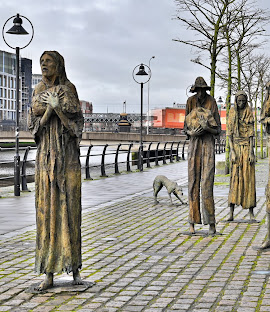
This Famine Memorial of life-size bronze sculptures can be found on the quayside by the Dublin Custom House.  The figures are depicted in this setting as they would have appeared walking toward a ship such as the Perseverance which left here on St. Patrick’s Day bound for New York.  The Perseverance’s 74 year-old captain, William Scott, should be remembered for bringing ALL crew and passengers safely to America.

The Vatican’s Meager Response to the Famine

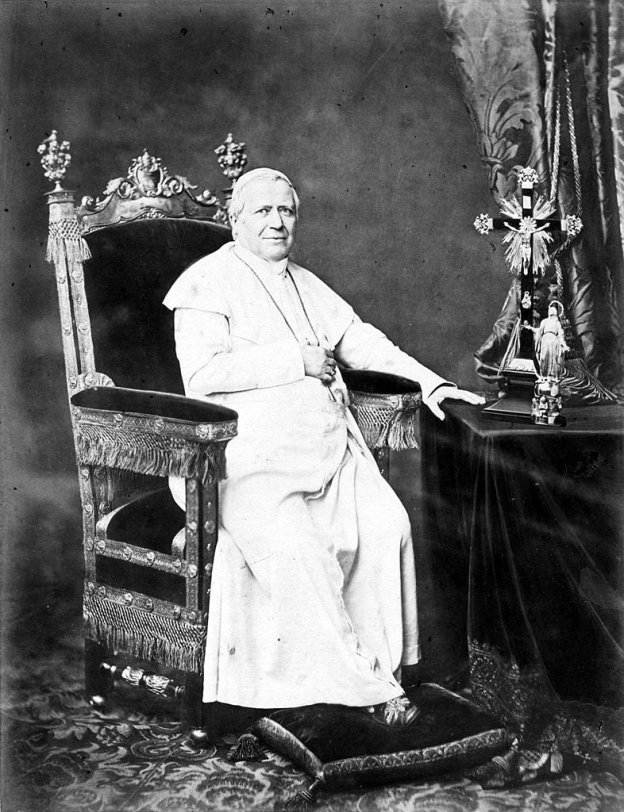
In 1846, the second year of the Famine, Pius IX was elected Pope.  He assumed control of the Papal States at a time of great political and social upheaval in Italy.  Initially hailed as a progressive reformer, once he’d personally experienced the chaos born of Italian nationalism and Austrian aggression, his attitudes changed dramatically.

One could argue that, when the political autonomy of the Papal States was slipping away, Pius IX wasn’t positioned to help the starving Irish aside from encouraging individual Catholics (not the establishment) to give to Irish relief (and he set a personal example by giving of his own purse) and to pray for the Famine’s victims.*  One could argue that, but I won’t.  The Pope was a political and spiritual leader of great influence and a young man (54) with the energy to affect change.   That he chose to use that energy and influence to remake the Catholic Church in England – something that hadn’t been done since the Reformation – and secure London’s undertaking to grant him political asylum should he need to flee Italy speaks to his priorities vis-a-vis Great Britain.  How much could he have accomplished if he’d chosen, instead, to use what influence he had with London to champion the cause of the starving?  What if he’d used the Vatican’s considerable wealth to save lives?  We’ll never know what Pius IX’s legacy would have been if he’d put the lives of Irish Catholics first, but we do know a bit about what the Irish Church accomplished.

Irish parish priests and Church leaders set up soup kitchens, raised funds and sought to exert political pressure both within Ireland and abroad. Archbishop Daniel Murray of Dublin, 77 at the start of the Famine, stands out for his efforts.  A man who advocated non-denominational education, encouraged Catholics to attend Queens (Protestant) College, supported Daniel O’Connell’s emancipation movement and was instrumental in establishing Dublin’s first Catholic hospital, Murray deserves a few hundred pages of description to adequately catalog his contributions.  Suffice it to say that he was one of many who didn’t wait for guidance from the Vatican before taking matters into his own hands.  Indeed, at one point the Holy See cautioned Irish Church leaders not to involve themselves in secular affairs that were beyond the scope of their ministries (e.g., running soup kitchens, encouraging their parishioners to pressure the British for aid).  Luckily, this guidance was ignored.

Take the case of Archdeacon O’Sullivan of Kenmare, County Kerry, who took it upon himself to import food directly, explaining to a Parliamentary commission that someone had to do it.

Or Paul Cullen, Rector of the Irish College in Rome (later Cardinal and successor to Daniel Murray as Archbishop of Dublin) who personally raised funds and ran interference between the Vatican and leaders of the Irish Church who felt that the Pope could have, and should have, done more.

Irish clerics reached out to their counterparts around the world, succeeding most significantly in raising money and awareness in the U.S.  In fact, one of the first Irish aid committees (perhaps the first outside of Ireland) to be established was the Irish Charitable Relief Fund set up in December, 1845 by Father Thomas O’Flaherty, parish priest of St. Mary’s Church in Salem, Massachusetts.  At the time, Father O’Flaherty raised the not insignificant sum of $2,000!

In short, the Irish Church stepped up to the plate at a time of national catastrophe while the Vatican’s efforts to aid Famine victims were limited at best.  Then, again, the Famine was only one challenge in Pius’ 32 year tenure, one in which the dogma of the Immaculate Conception (accepted by rank and file Catholics for hundreds of years) was finally defined; and Papal Infallibility accepted.  Clearly Pope John Paul II saw something in Pius IX to admire, for he was responsible for the veneration and beautification of the man – two of the 3 steps toward canonization.

* these public prayer sessions lasted three days (an indulgence of 7 years – a reduction, presumably, in Purgatory time – was granted to those attending) and the stated goal wasn’t just to help Irish Famine sufferers but to ask that famine not be visited on other parts of Europe.  Now I believe in the power of prayer, but it must be coupled with human action to the extent within our power.  I can not imagine a deity who would accept/demand less of us.

British Troop Strength in Ireland During the Famine

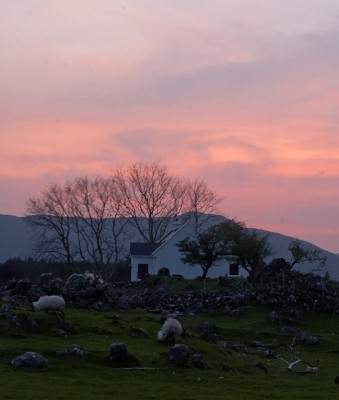
sunset with sheep-troop strengthAlthough exact figures are tough to come by, a conservative estimate of British troop strength during the Famine (not including local constabularies) is 100,000.  By way of comparison, in 1845-46, the British only maintained about 20,000 troops in the Punjab where they were fighting a Sikh army of 80,000!

The 100,000 troops sent to Ireland were tasked with keeping a mostly impoverished population of 8 million in line – guarding food exports (enough food was being exported from Ireland to feed the starving if it had been kept in country); quelling food riots; and,  protecting the interests of landlords and landed.   Bear in mind that Ireland is roughly 32,000 square miles – the size of Indiana.  With the exception of a very small number of armed men intent on exacting revenge against landlords like Major Mahon who were seen as exploiting the Famine, British troops in Ireland faced a starving, rebellious populace who might riot for food, but posed no military threat.

A point of comparison – the U.S. military maintained roughly 100,000 troops in Afghanistan at the height of that war, a country of over 28 million with a land mass of 250,000 square miles.   Unlike Famine-ravaged Ireland, the U.S. faced a heavily armed Afghan insurgency.

The comparison of these data certainly gives one pause.

The Nutritional Value of the Potato: the pre-Famine Irish Diet

potatoPotatoes are a nutritionally complete food.  A medium-sized potato supplies 7.5 grams of protein* and 8 grams of fiber.  In addition, potatoes contain Omega 3 and 6 fatty acids, 28 grams of Vitamin C and significant levels of calcium, magnesium, phosphorus, iron, vitamin B, iodine, vitamin K and vitamin A.  Potatoes are low in sodium and contain no cholesterol.

Two vital nutrients missing in potatoes are vitamins D and E.  Pre-Famine Irish tenants doubtless got sufficient vitamin D from the buttermilk they ate with their potatoes.  Vitamin E was probably obtained from turnips, cabbage and oatmeal – other staples of the working class Irish diet prior to the Famine.

Irish poor also ate herring and other fish when they could, but usually only had meat on the holidays.

* The protein derived from potatoes is considered ‘complete’ since potatoes contain so many amino acids.

The British Queen That Fateful Voyage of 1851

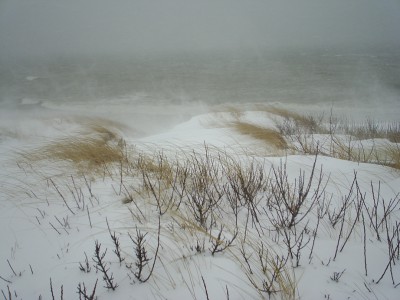
cape cod beach The British Queen was a 66-year-old steam packet (and former slave ship) pressed into service to carry Irish emigrants to America.*  In December of 1851, its 228 passengers must have felt relief when the 2-month winter voyage seemed at an end, for land had been sighted.  But instead of berthing in New York, the ship had been blown off course and was headed toward Nantucket Island off the coast of Massachusetts.   A blizzard blew the ship inland toward ice floats that soon had the British Queen aground.  12 miles from Nantucket Harbor, the captain stowed the sales and sent up a distress signal:  the Union Jack flying upside down.  Temperatures dipped below freezing as crew and passengers huddled together on the deck and prayed.  The ship’s hold took on 11 feet of water that last night and two passengers died of the cold.

On land, a fire lookout posted in the tower of a church had seen the ship through his telescope and sounded the alarm.  Rescue plans began, but nothing could be done until the raging storm subsided.  Sailors gathered in the harbor’s abandoned warehouses (the whaling industry that helped support the islanders had died out years before) and decided that a paddle steamer should tow two schooners (captained by the Patterson brothers) past the harbor’s sand bar at midday’s high tide; the schooners would then set off and rescue the British Queen’s passengers.

One can only imagine how the crew and passengers of the British Queen felt at the sight of their rescuers.  Amid lashing winds and waves that rose the small schooners above the wreck before plunging them back to the shoal, passengers were transferred from the sinking British Queen as dusk fell and the tide turned.  Every passenger was rescued safely and by 5:00 pm all were headed back to the harbor.  The islanders split up the survivors, housing them in churches and private homes and, on Christmas Day, most boarded a paddle steamer to continue their journey to New York.

A small number of the British Queen’s passengers chose to stay on Nantucket and make their home among the people who had saved them.  Their descendants live there to this day.

* for a more detailed account of this incredible rescue, see Edward Laxton’s The Famine Ships (Henry Hold and Company, 1996)

England’s Great Exhibition of 1851

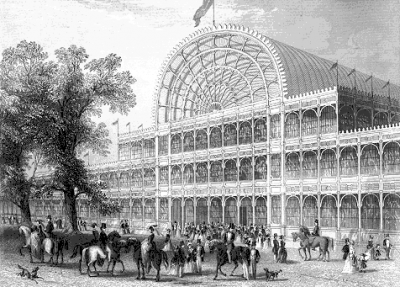
Pictured here is the cast-iron and glass Crystal Palace (990,000 square feet enclosing 19 acres).  Built in Hyde Park at a cost of £150,000, it housed the ‘Great  Exhibition’ – a pet project of Prince Albert, Queen Victoria’s husband.

In the final years of the Famine, London was busy planning its Great Exhibition – a sort of World’s Fair that would highlight Britain’s economic and industrial power as well as innovations from other countries.  Under Prince Albert’s leadership, over a quarter of a BILLION pounds sterling were raised to fund the project.   The Great Exhibition attracted 6.2 million visitors who paid an admission fee of up to £4  to marvel at the technological wonders highlighted therein.  Money raised by the Exhibition was then used to build the Victoria and Albert Museum and fund other pet charities of the royals.

How, one might ask, did this perverse expenditure of funds and flaunting of Britain’s greatness occur while Ireland was starving and mourning the death of 1 million and the emigration of 1.5 million?  After all, London had argued that it hadn’t the money to save Famine victims and that getting what aid there was to the starving was a logistical nightmare.  YET Britain found a way to construct the Crystal Palace in 9 months, house it in a park containing fountains sprouting 120,000 gallons of water 250 feet in the air, and mount 14,000 exhibitions and displays sent from countries across the globe.

As inexplicable as it is to contemplate Britain hosting an international event to effectively pat herself on the back while across the Irish Sea 1/3 of the Irish were dead, dying or fleeing for their lives, it must be remembered that the Great Exhibition of 1851 was all about progress.  Technological and industrial that is, not ethical or moral.  It was about machines helping man – not men helping each other.  It was about envisioning an industrialized future with no place for one room cabins where families ate the same food every day, huddled barefoot before peat fires and lived hand to mouth.

Richard Martin: MP for Galway, Animal Rights Activist & Irish Nationalist

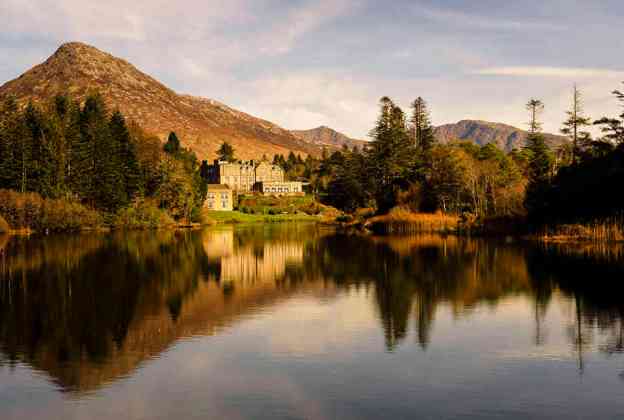
Ballynahinch Castle, above, the home of ‘Humanity Dick’ Martin and now a hotel.

Richard Martin, a wealthy Protestant born into one of the 12 tribes of Galway and raised on land that once belonged to Grace O’Malley, was an M.P., supporter of Catholic Emancipation, and humane landlord.  Martin owned 200,000 acres in County Galway which made his estate, in the 1830’s, the largest in Ireland.  During the 1839 potato shortages in Galway, the Crown’s eyes on the ground – Captain Chads – sent 13 reports back to London praising Martin (and others) for his efforts to alleviate the distress.  Richard Martin is noteworthy for something else: he was an animal rights activist at a time when such things were not in fashion.  He earned the nickname ‘Humanity Dick’ when the Prince of Wales, later King George IV, recognized his Parliamentary efforts in aid of animals.  Richard Martin later founded the Society for the Prevention of Cruelty to Animals.

Richard Martin’s Irish estates were lost during the Famine and he died in France, exiled from his homeland because of debts and scandal.  But his legacy lives on in the minds of those who remember those landlords who, though of Norman or Protestant stock, stood with their tenants against the evils of religious discrimination and in opposition to London’s apathy in the face of mass starvation.

Embedded Witness: The Story of Vere Foster

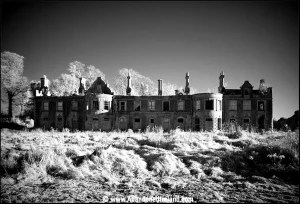
Glyde Court, County Louth, above, ancestral home of Vere Foster; the house is now in ruins.

By 1847, there was no shortage of press reports and first-hand accounts of the horrors experienced by emigrants taking ship from England or Ireland to North America.  Despite this, Britain did little to enforce the provisions of the Passenger Act which delineated how much space each passenger was to be allotted, that ships carry lifeboats, and that a pound of food and 3 quarts of water per day be provided to each passenger.  As little influence as the authorities chose to exercise over British captains and crew, they did even less to keep American shipping companies in line.

In order to bring attention to the horrific conditions aboard some of the ‘coffin ships’ where mortality rates were 20% or more, a group of wealthy and/or well connected booked passage along with the starving masses.  One of these men is profiled below.

With 933 others, Vere Foster boarded the USS Washington in October, 1850, bound for New York.  (He was to make 3 such voyages).  The ship was owned by the Black Star Line, notorious for putting to sea a number of  miserably run packets ships  – the William Rathbone and the Atlas among them.  Foster, an Irishman and graduate of Eton and Oxford, had never known want.  His family were landed gentry, his father a diplomat.  Yet, Foster made helping the less fortunate of his homeland his life’s work.

While on board the Washington, Foster kept a record of how the passengers were starved and brutalized.   When he petitioned the captain on their behalf, he was beaten but managed to wrest some food for his fellow passengers.  At the journey’s end, 130 of the Washington’s passengers put their name to a written indictment of the captain which Foster forwarded to a friend who raised the matter in the House of Commons and the House of Lords.  No action was taken against captain or crew, but in time the laws changed, perhaps due in part to men like Foster.  He went on to write a pamphlet called the Penny Emigrant Guide in which he detailed what emigrants should expect aboard ship and how they should prepare for an Atlantic voyage.

Vere Foster died in Belfast at the age of 81.  He enjoyed considerable success as a drawing master, but it is for his philanthropy – supporting the Irish education system, underwriting the passage of many emigrants to North America, and experiencing first-hand the privations of a crossing – that he is most remembered.

The South Street Seaport: The Famine-Era ‘Port of New York’

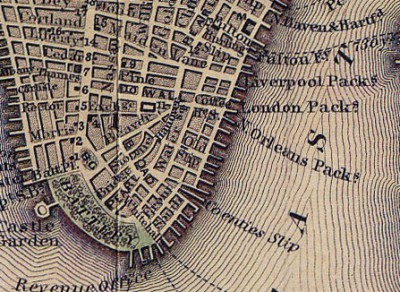
Southstreet Seaport Lower Manhattan docks as they appeared in the 1840’s.  Note where the Liverpool (and undoubtedly Galway, Dublin and Cork) packet ships would have docked.   Of course, the Brooklyn Bridge hadn’t yet been built.

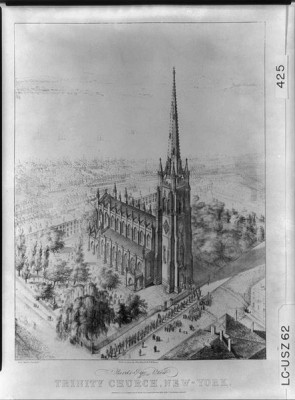
Over half a million Famine survivors entered the U.S. through the South Street Seaport.  Much has been written of what new immigrants experienced after 1-2 months at sea when land was finally sighted.  They would have sailed around Long Island, seeing green fields and much else that might have been familiar to those raised on farms.  After a week of this, the Manhattan skyline would have come into view.  Although there were few buildings over three stories at that time, Manhattan would have been an awesome sight.  What I’d like to draw the reader’s attention to is one building that would have dominated the lower Manhattan skyline as it was only 7 blocks from the pier:  Trinity Church.


Spires of the Anglican Trinity Church (surrounded by green) visible just north-west of Manhattan’s South Street Seaport (1850).


trinity churchPictured here in 1846, Trinity Church was built in Lower Manhattan in 1697.   A royal charter for its construction was given by England’s King William III – the same ‘King Billy’ who had defeated the Catholic (Jacobite) King James during their game-changing battle in Ireland less than a decade earlier.  It was the defeat of James, and his subsequent flight to France with many Catholic Irish nobles, that was to prove such a watershed in Irish/British history. Once William of Orange and his queen secured the British (and Scottish) thrones, the penal laws targeting Irish Catholics for discrimination followed in short order.

Take a moment to consider how Famine immigrants felt when they gazed up at Trinity’s spires – at the Anglican church that dominated lower Manhattan much as the Anglican church and her Crown supporters had so dominated their lives.   They couldn’t know how their exodus to freedom would some day reshape Manhattan; they couldn’t know that within a generation they’d be pulled into a civil war not their own; they couldn’t know that within five generations they’d help pull Britain back from the brink of destruction – twice.  No, they didn’t know all that.  But they knew enough to make their way past Trinity Church to Mulberry Street, finding there Saint Patrick’s Old Cathedral (dedicated in 1815).   A more modest building than Trinity, it was the seat of the New York Archdiocese until the consecration of the ‘new’ Saint Patrick’s Cathedral on Fifth Avenue and was the parish church for the neighborhood’s Irish immigrants.
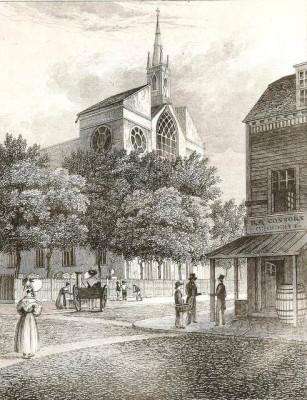
old saint patrick'sSaint Patrick’s Old Cathedral on Mulberry Street in Manhattan (about 1815).

The Voyage of the USS Jamestown

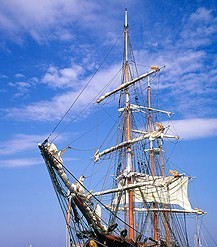
the jamestownDuring the Famine years, 5000 Atlantic crossings were made to bring 1 million Irish emigrants to America.  Many cargo ships brought relief supplies in the opposite direction; one of these deserves special mention.

In 1846, the second year of the Famine, America was blessed with a bountiful harvest.  While American Quakers and other groups were busy organizing relief efforts, Vice President Dallas held a public meeting in Washington to urge every town and city throughout the land to help the starving Irish.  Goods were transported by land and water toll-free, packages labeled Irish Aid were carried free of charge by the railroads.  Despite the war then raging with Mexico, Congress voted that two of its 6 warships be de-armed, refitted as cargo ships and made available to the aid effort.

One of these ships was the USS Jamestown, named for the Virginia settlement that was named for the English monarch James I.  As the baptized son of Mary Queen of Scots, James I was first King of Scotland and then King of England after Elizabeth I named him her successor.  He epitomized the new Tudor England – Protestant, but born of Catholic stock.

Three weeks after Congress authorized the Jamestown’s refitting for civilian purposes, it sailed into Boston Harbor to be loaded on St. Patrick’s Day by dock workers who’d waived their salaries to outfit the sloop with $36,000 worth of food aid.  The crossing to Ireland took 15 days.  Upon their arrival in Cork City, Captain Robert Forbes and his crew were met by a band.  Forbes was given a brief tour of the city by the local priest, Father Mathew.  Only a few feet from the dock, Forbes writes of seeing “a Valley of the Shadow of death.  I saw enough in five minutes to horrify me.  Some called for water to Father Mathew and others for a dying blessing…hundreds begging for which I can readily conceive would be refused by well-bred pigs in America.”

Take a moment to think about that St. Patrick’s Day at Boston Harbor; about two Houses of Congress designating that a warship be refitted to feed the hungry; about what James I (who ordered Sir Walter Raleigh executed to appease Catholic Spain) would think of the warship that bore his name.  Imagine what the inhabitants of Cork City felt when they saw the Jamestown come into view – the utter majesty of it, the hope that surged if only for a brief time.


Forced March to Delphi Lodge

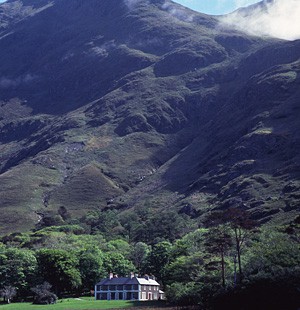
adelphiDelphi Lodge, Connemara Ireland – now a luxury hotel

On March 30, 1849 (4 years into the Famine), two relief officials (Colonel Hogrove and Captain Primrose) came to the town of Louisburgh in County Mayo to ‘inspect’ (i.e., certify) those receiving outdoor relief (such relief did not include shelter, only limited food in exchange for manual labor).   Hundreds of the starving and destitute had traveled great distances to Louisburgh for this ‘inspection’; it never took place.  Instead, the two officials left for the Delphi hunting lodge about 14 miles away!  Those who’d gathered in the hopes of continuing to receive the meager aid to which they were entitled were told to walk along the snowy mountain trails to Delphi Lodge and to be there by 7:00 the next morning or else they would be ‘struck off the relief’*.   Hundreds of ‘living skeletons’* made the forced march, some dying along the way and many thereafter.   Arriving by 7:00 the following morning, the exhausted victims waited until noon (the officials were lunching) when they were duly ‘inspected’.   They were then left to make their way back to their homes, some traveling in excess of 20 miles as they did not live in Louisburgh.

Imagine, if you will, what went through the mind of Catherine Dillon as she struggled through the cold mountain path toward Delphi with her son, Pat, and daughter, Honora.  Catherine had traveled 2.5 miles to Louisburgh the morning of the 30th in the hopes of receiving a bit of meal in exchange for her labors.  Instead, she was told she and her family had to walk an additional 14 miles to Delphi.  Wearing probably the flimsiest of clothing (as outdoor relief workers were not provided with clothing), debilitated by 4 years of hunger, she sets off only to die midway through her last agonizing journey in this world.  The bodies of all three Dillon’s were left exposed on the road for three days and nights for ‘the dogs and the ravens to feed upon’* (as set forth in a prior posting, outdoor relief workers were not provided with coffins when they died).  Catherine Dillon eventually received a Christian burial when the local priest, Thomas O’Dowd, stepped in and provided coffins for the dead.

A  memorial march is held annually to commemorate this forced march.  It is generally referred to as the Doolough March as most died on the shores of Doolough Lake.  Although the exact number of those who perished on the forced march to Delphi Lodge will probably never be known, local sources put the number in the dozens.

*  see letters to the Mayo Constitution dated April 5, 1849 and April 13, 1849.


The Execution of Landlord Denis Mahon

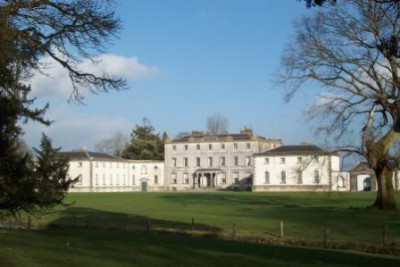
stokestown Stokestown Park, County Roscommon

Irish Landlord Major Denis Mahon, owner of Stokestown House in County Roscommon, was shot to death in 1847 while driving his carriage four miles from his home.  Within an hour of the shooting, bonfires lit by the tenants of his property dotted the hills of his 11,000 acre (28 village) estate.  Why were these signal fires lit?  Presumably to spread the words that the hated landlord had been killed – a hollow (perhaps Pyrrhic) victory for those thousands of starving tenants who had managed thus far to avoid eviction or forced emigration since such evictions continued after his death.

Journalist Peter Duffy* maps out what led up to the shooting through an exhaustive examination of contemporary sources.  Unfortunately, he also does backflips at times to find in Mahon’s eviction orders a hint of remorse or regret.  Duffy writes of the ‘churnings of [Mahon’s] conscience’, noting that ‘it is hard to imagine that [Mahon] did not have qualms about his [eviction] decision.’  As much as I can appreciate Mr. Duffy’s need to find some redeeming qualities in the murdered man, the evidence simply does not support his kindhearted conclusions.

Here are the facts:

– Mahon spent much of the worst months of the Famine comfortably ensconced in London’s Claridges Hotel, leaving day-to-day control of his estate (and the fate of his 11,000 tenants) in the hands of his estate manager.

– When it became clear that revenues from his starving tenants wouldn’t continue to support his lavish lifestyle, Mahon ordered mass evictions so that his property’s tillage land could be converted to pasture – a move considered essential if the estate was to continue to be bled dry.

– Mahon’s estate agent was well aware of the wretched state of the tenants he ordered from their homes.  Three decades later he recalled, ‘of course, they were all absolutely starving’.*   As evidence of his compassion, he told authorities that he sometimes allowed tenants evicted by his ruffian crowbar brigades (see a later post on this practice) to keep part of the thatch from their destroyed homes so that it could be used to cover the ditches where they would huddle after eviction!

– Mahon initially proposed spending 24,000 pounds to send thousands of his tenants to America.  When it came time to pay, he had second thoughts, opting instead to spend only a few thousand on the cheapest passage possible – to Canada .  Mahon personally negotiated low rates with Liverpool’s least reputable shipping agents.  The results were  foreseeable as the death rate on Mahon’s coffin ships exceeded 50% – a staggering statistic.  The Times of London reported that ‘the Black Hole of Calcutta was a mercy compared to the holds of these vessels’.   Dr. Douglas, the heroic physician charged with overseeing medical services at Canada’s Grosse Isle quarantine station, specifically named Mahon as being responsible for sending his way ‘the most wretched, sickly, miserable beings I ever witnessed.’*

Mahon’s execution was greeted with outrage in England and fear on the part of Irish landlords who fled the country to avoid a similar fate.  Their fear was well-founded as, within a week of his death,  four more Irish landlords were shot.  Two men were eventually hanged for the Mahon killing.

Regrettably, the ‘clearance’ policies implemented by Mahon continued after his death with chilling results:  although Ireland as a whole lost 1/3 of her people to death, emigration and disease during the Famine years, the Mahon estate lost 50%.  And the efficacy of Mahon’s policies?  Well, if the goal was profitability and nothing else, his reasoning was spot on for unlike the majority of Irish landlords who found themselves bankrupt or close to it after the Famine, Mahon’s descendants thrived and were able to double the size of the estate (from 11,000 acres to over 26,000).

One final note:  Ireland’s Famine Museum is located on the Stokestown estate.

* The Killing of Major Denis Mahon by Peter Duffy (Harper Collins, 2007)


Souperism and the Politics of Aid

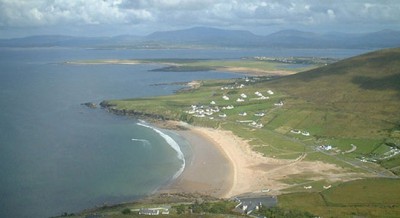
dugortDugort Strand, Achill Island, Ireland

When Quakers opened soup kitchens to feed Famine victims, they faced a number of obstacles – logistics, financing and a London government philosophically opposed to providing outright aid.  But the most heart-breaking challenge they faced was from the starving themselves, for Irish Catholics were suspicious of well-meaning Protestants.  And for good cause.

Souperism – the giving of food by well-heeled Protestants to poor Catholics provided the latter abandoned their faith or at least pretended to – had a long history in Ireland.  Although the VAST majority of Famine-era Protestant clergy abhorred and excoriated this practice, a vocal minority did embrace it.  One infamous example is that of Reverend Edward Nangle, a Protestant evangelist who viewed the Famine as G-d’s judgment upon the Catholics whom he saw as guilty of idolatry given their belief in transubstantiation (bread and wine becoming the Eucharist).  From his base in Dugort, Achill Island (County Mayo) Nangle did all he could to exploit the tragedy and further his own agenda, sending forth his minions to condemn and convert Famine victims.  Although his name lives in infamy, the damage done by Nangle was long ago eclipsed by the good affected by Quakers and Church of Ireland clergy who worked side by side with their Catholic counterparts to defeat the scourge of hunger.

Offering aid with strings attached, whether the proselytism advances a religion (as during the Irish Famine) or a political system (as today when the needy of ‘good’ countries who embrace democracy are rewarded while others are not) is nothing new.  But it bears remembering that missionary zeal in any form is an affront to decency for self-interest, however enlightened it may appear to be, has no place in the politics of aid.

The Price of Outdoor Relief

irish high cross   Although the 1845 potato crop failed in Autumn of that year, a large portion of the crop had been harvested – enough to see many people through the winter. But when the crop failed again in 1846, there were increasing calls for London to intervene. The response was to set up so-called ‘outdoor relief’ works, the philosophy being that the starving shouldn’t be given a hand-out but made to work for food.

-By October of 1846, these public works projects grew to employ 250,000 with the number jumping to 720,000 within 6 months. What was outdoor relief? Simply put, one spent the day outside breaking stones, building roads or digging ditches in exchange for the payment of 1 shilling – enough to buy a meal of stirabout (oatmeal porridge) for a family of 3 and nothing more…no second meal, no clothing or fuel. Even so, public works tickets were eagerly sought and riots broke out among those seeking work.

-Unfortunately, payments to workers were often delayed as in the case of Denis McKennedy who died on October 24, 1846 while working on a road in western County Cork. He had not been paid for 14 days and an autopsy revealed no food in his stomach or intestines. The coroner’s inquest returned a verdict that Mr. McKennedy had ‘died of starvation caused by the gross neglect of the Board of Works.’ Mr. McKennedy’s death was not an isolated incident and those employed on the public works were not provided with coffins when they died. As unbelievable as it sounds, London’s policy was to simply leave his body by the side of the road to be eaten by dogs.

The Famine, the American Civil War and the Fenians

fenianJohn O’Mahony, who was tasked with establishing the American-based Fenian Movement. O’Mahony derisively referred to Irish Americans as ‘tinsel patriots’ but understood the necessity of American money and influence if Ireland was to achieve independence.

Although Irish had struggled, in one form or another, for independence from Britain throughout its 800-year subjugation of Ireland, it was the horror of the Famine that gave birth to the international independence movement known as the Fenian Brotherhood*.  The Fenians (of which the Irish Republican Brotherhood, a precursor to the IRA of modern times, was part) had much in common with the Irish secret societies which had come before in that they advocated violence in pursuit of Irish independence, but the Fenians went one step further.  Whereas previous secret societies had been agrarian-based and mostly local, the Fenians saw the struggle for Irish independence as one where diaspora Irish could not only have a voice but play a part.  Brilliant, if twisted marketing:  Irish Americans might not be able to fight the British directly, but they could subsidize those who did by providing cash, arms, political influence and secrecy.  Think of it as a perverse take on the penitential power of the survivor:  through actions taken in America, Irish Americans could help free their brethren suffering under British rule much as the actions of the living could affect the fate of loved one’s awaiting judgment in Purgatory.

American aid for the Fenians ebbed and flowed with the fortunes of working class Irish Americans during the decade following the Famine.  The economic recession that gripped America in the early 1860’s might have temporarily dried up financial support, but the American Civil War provided military training for thousands of Irish Americans and legitimized the belief that resolving sectarian violence by force was justified.

The Civil War also inflamed Anglo-American relations.  Although Great Britain was officially neutral during the war, its shipyards built two warships for the Confederacy and an international tribunal subsequently awarded the U.S. 15.5 million dollars for damages done by these British-made ships.  Would the British more overtly aid the South?  Fears ran high at times.  Confederate president Jefferson Davis believed that Britain’s dependence on Southern cotton would be a decisive factor in garnering British diplomatic and military support for secession.  Unfortunately, he did not factor in Britain’s long-standing tension with France and her growing distrust of Bismarck’s Germany – both of which claimed London’s attention and resources.  For his part, President Lincoln endeavored to portray the War Between the States as only that: an internal conflict, not a matter within the purview of international law.

As to the issue of slavery, it had been outlawed in Britain for thirty years (G-d bless the memory of William Wilberforce and his colleagues), so to support a Southern economy so dependent on the slave trade would have been a hard sell for London at home.  Then there’s the 1861 Trent affair during which a U.S. naval vessel fired on a British (neutral) ship carrying two Confederate emissaries to Europe.   Although the British fleet was put on a war footing as a result and there was much saber rattling in Whitehall, Lincoln sagaciously released the captured men, confident that this conciliatory move, coupled with the fact that the North was providing Britain with 30% of its grain imports at the time, would defuse tensions.  He was right – in this as in so much else.  Still, for the first years of the war it appeared that the South might win or at least not lose.  If that happened, would London weigh in?  If so, what would France do?  All of this uncertainty meant that anti-British sentiment during the War ran high – a boon to the efforts of the Fenians who made great strides at the time on the public relations front.  Their efforts in the 19th Century may have failed to free Ireland, but they laid a foundation of support in America that materially sustained the Fenians and their IRA offspring during the Troubles to follow.  Thus history came full circle, for it was Famine survivors who had been forced by British action and inaction to emigrate to America who were to prove such an effective weapon in the war for Irish independence.

* named for the Fianna, a mythical military unit led by the warrior Finn MacCool who protected Ireland from foreign invasion.

Parliament’s Oath of Renunciation and the Irish Church

glencar countryside In the wake of King James’ defeat at the hands of the Protestant King William of Orange, some Catholic priests fled Ireland, some were induced to convert to Protestantism (for a payment of 40 pounds a  year), and some were arrested (a reward of 100 pounds was paid if one turned in a bishop, 30 pounds for a Jesuit).  Many priests, however, went underground or otherwise operated below London’s radar.  Not content to have any Catholic clergy remaining in Ireland, in 1703 Parliament passed a law that required all Irish Catholic clergy to register with the authorities so that ‘the government be truly informed of the number of such dangerous persons as still remain among us’.   1089 priests came forward to register their identities.  Within a few years, Parliament passed the ‘Popery Act’ which aimed to ensure that the Protestant succession to the throne was recognized by all.  It required that Irish Catholic clergy take an oath of allegiance known as the Oath of Renunciation (or Abjuration).  Although the Pope forbade the taking of such an oath, 33 Irish clergy did do so, thus affirming the right of Protestant Queen Mary and her heirs to rule.

One is tempted by these facts to get caught up in condemning those clergy who caved to pressure, but instead we should  marvel that so many didn’t at a time when Rome was hardly in a position to protect her servants any more than the Catholic aristocracy could for many of them had fled Ireland with the defeated James.  So, for me, the story here is to be found in the lives of 1056 priests who clung to their faith in the face of adversity or, to paraphrase Lillian Hellman, refused to cut their conscience to fit the fashion of the times.

How the Famine-era Irish Planted Potatoes

potatoes

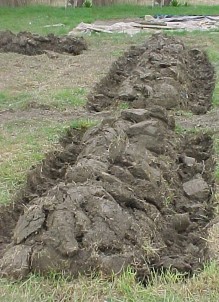
-There’s quite a bit of nonsense on the Internet about how the Irish grew potatoes. First of all, the appellation ‘lazy beds’ was coined by the English to describe the Irish practice of planting potatoes in raised beds. The term is derogatory and shouldn’t be perpetuated, even if one can appreciate that to English gardeners trained to turn over and work the soil before planting, Ireland’s millenia old practices seemed bizarre. Yet ridge planting worked well in a wet climate where drainage was a problem. An acre could yield up to 12 tons of potatoes and be worked by one family. That’s 3x the results you’d get with traditional farming.

-Here’s how ridge planting worked.

1. Parallel lines were cut through turf at about 4 foot intervals. Manure, seaweed, kelp or any other fertilizer (sea shells for instance for they are rich in lime) were placed on the space between the lines. This was the base of a raised bed.

2. Turf was cut (with a simple spade) from the outer edge of the raised bed and flipped over. Now the raised bed had lasagna layers of turf, fertilizer and upended turf. Thus, the area now facing up was soil (not turf) and easy to dig in.

3. Seed potatoes were then planted in the upturned turf and covered with spaded soil from the ridges in between the raised beds.

-This method ensured that the seed potatoes weren’t in direct contact with the base soil (which would easily flood during rainy times) but it was laborious. Remember that wheeled carts would not have been available to carry the seaweed or manure. Instead, it would be carried one back-breaking basket at a time (as in the film ‘Man of Aran’ which depicted life on the Aran Islands). If one had access to a donkey, a slide cart could be used: a basket that slid on the ground and was attached by ropes and sticks to a donkey.