
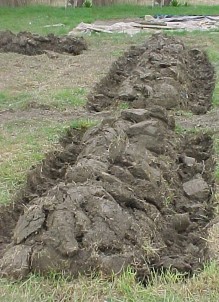
-There’s quite a bit of nonsense on the Internet about how the Irish grew potatoes. First of all, the appellation ‘lazy beds’ was coined by the English to describe the Irish practice of planting potatoes in raised beds. The term is derogatory and shouldn’t be perpetuated, even if one can appreciate that to English gardeners trained to turn over and work the soil before planting, Ireland’s millenia old practices seemed bizarre. Yet ridge planting worked well in a wet climate where drainage was a problem. An acre could yield up to 12 tons of potatoes and be worked by one family. That’s 3x the results you’d get with traditional farming.
-Here’s how ridge planting worked.
1. Parallel lines were cut through turf at about 4 foot intervals. Manure, seaweed, kelp or any other fertilizer (sea shells for instance for they are rich in lime) were placed on the space between the lines. This was the base of a raised bed.
2. Turf was cut (with a simple spade) from the outer edge of the raised bed and flipped over. Now the raised bed had lasagna layers of turf, fertilizer and upended turf. Thus, the area now facing up was soil (not turf) and easy to dig in.
3. Seed potatoes were then planted in the upturned turf and covered with spaded soil from the ridges in between the raised beds.
-This method ensured that the seed potatoes weren’t in direct contact with the base soil (which would easily flood during rainy times) but it was laborious. Remember that wheeled carts would not have been available to carry the seaweed or manure. Instead, it would be carried one back-breaking basket at a time (as in the film ‘Man of Aran’ which depicted life on the Aran Islands). If one had access to a donkey, a slide cart could be used: a basket that slid on the ground and was attached by ropes and sticks to a donkey.
 Ariella Abruzzi Novelist