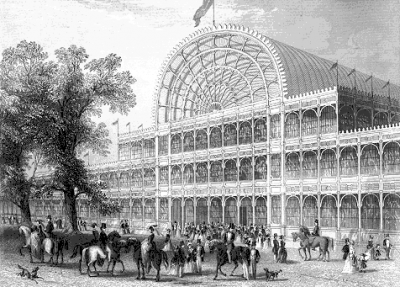
Pictured here is the cast-iron and glass Crystal Palace (990,000 square feet enclosing 19 acres). Built in Hyde Park at a cost of £150,000, it housed the ‘Great Exhibition’ – a pet project of Prince Albert, Queen Victoria’s husband.
In the final years of the Famine, London was busy planning its Great Exhibition – a sort of World’s Fair that would highlight Britain’s economic and industrial power as well as innovations from other countries. Under Prince Albert’s leadership, over a quarter of a BILLION pounds sterling were raised to fund the project. The Great Exhibition attracted 6.2 million visitors who paid an admission fee of up to £4 to marvel at the technological wonders highlighted therein. Money raised by the Exhibition was then used to build the Victoria and Albert Museum and fund other pet charities of the royals.
How, one might ask, did this perverse expenditure of funds and flaunting of Britain’s greatness occur while Ireland was starving and mourning the death of 1 million and the emigration of 1.5 million? After all, London had argued that it hadn’t the money to save Famine victims and that getting what aid there was to the starving was a logistical nightmare. YET Britain found a way to construct the Crystal Palace in 9 months, house it in a park containing fountains sprouting 120,000 gallons of water 250 feet in the air, and mount 14,000 exhibitions and displays sent from countries across the globe.
As inexplicable as it is to contemplate Britain hosting an international event to effectively pat herself on the back while across the Irish Sea 1/3 of the Irish were dead, dying or fleeing for their lives, it must be remembered that the Great Exhibition of 1851 was all about progress. Technological and industrial that is, not ethical or moral. It was about machines helping man – not men helping each other. It was about envisioning an industrialized future with no place for one room cabins where families ate the same food every day, huddled barefoot before peat fires and lived hand to mouth.
 Ariella Abruzzi Novelist