 Four years into the Famine, most of the Poor Unions set up to run Ireland’s workhouses were in dire straits – overwhelmed by the demand for relief and all but bankrupt as the only funding they received was from local landlords (not the British). Even the Quakers had closed their soup kitchens, concluding that the acute demand for help was beyond their means. They focused instead on giving seeds for new crops to be planted and lending funds for fisheries or other self-sustaining projects. Did London step in to the breach? Only to the tune of 50,000 pounds.
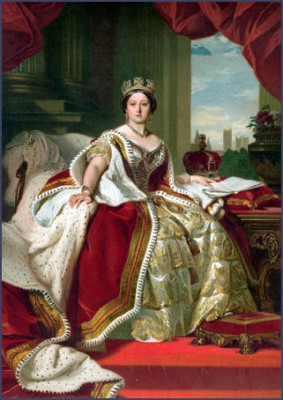
As incredible as it seems, during that horrible year it was decided that Queen Victoria should visit Ireland at the expense of the Irish. Billed as a ‘non-State’ visit, London refused to foot the bill for the party of 36 (Victoria and Albert decided at the last minute to bring 4 of their children in addition to many servants). A special carriage lined with ‘royal blue’ silk was built in Ireland to transport the royals. As Dublin scrambled to make itself presentable, THOUSANDS of pounds were spent sprucing up the areas the royals would see. The Times of London reported the building of ‘triumphal arches, platforms and devices on all sides’. Dublin Castle was given ‘a clean face’ and the State Apartments redone. Gas and electric lighting were introduced to the exterior of Dublin’s public buildings so that the city appeared prosperous and thriving. How much did this all cost the Irish? It’s difficult to estimate, but bear in mind that, at that time, a family of 5 could live for a week on half a crown (or 1/8 of a pound); thus, even if the royal tab was only 10,000 pounds, that amount of money could have fed 80,000 Irish families for a week. As reported in the Evening Mail, ‘if we have funds to spare let them be spent not on illuminations [of the capitol] but on Her Majesty’s starving subjects’.
Victoria’s visit (her first) was hailed a ‘public relations success.’ Why? How did the Queen choose to spend her time in a land ravaged by Famine and disease? She attended balls and parties, viewed fire works displays, and made procession through the streets of Cork, Belfast and Dublin. The only reference she made publicly to the fact that the Irish were starving was in one speech: “I gladly share with you the hope that the heavy visitation, with which Providence has recently visited large numbers of my people in this country, is passing away.” By placing blame at Heaven’s gate, the Queen absolved herself and her Government of any responsibility to take action. In so doing, she echoed the underlying philosophy of London during those fateful years that, because the blight was an act of Nature, man had a right to profit from it, exploit its victims and ignore its consequences.
Did the Queen visit a workhouse? No. Did she visit a fever hospital? No. Did she visit an orphanage? No. Did she visit a farm and see fields lying fallow? No.
It is noteworthy that the Royal visit was not disrupted by demonstrations or violence. Why bother? What impact would a public outcry have made on someone so clueless? Surely there was no need to draw her attention to the facts since her own newspapers were full of them on a daily basis.
 Ariella Abruzzi Novelist