 The Great Famine (an Gorta Mor in Gaelic) began in 1845 and ended in 1851-2. It resulted in a loss to Ireland of of 2.5 million souls (out of approximately 8.1 million) in just over 5 years – over 30%! That staggering number includes death by starvation and disease; averted births; and, emigration. The equivalent on an American scale would be a loss of over 100,000 million.*
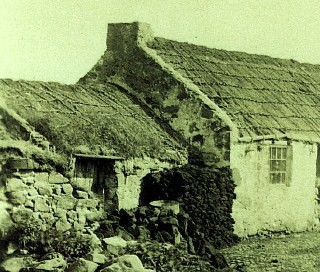
At the outbreak of the Famine, life for most Irish tenant farmers was harsh. They lived in 1 room cabins with dirt floors and cooked their food over an open fire. Animals were kept in a corner of the cabin and people had few possessions (shoes would have been rare). Irish land laborers lived under the English land law as quasi-slaves. They paid rents 80% higher than in England and lived in a perpetual state of semi-starvation and fear of eviction if they couldn’t pay their rents. Through a combination of discriminatory laws and practices (limiting what Catholics could own, sell, buy, etc.) that had been in place for centuries, by the 1840’s most Irish farmed only small plots of land. Approximately 1/2 of them depended on the potato as their SOLE food source as other crops (grain, barley, corn) were exported to England.
So how did the Famine happen? Although there had been partial crop failures (15 in the early 19th Century) the Great Famine was on a scale never seen before. It began with the failure of the 1845 summer harvest and was caused by a fungal disease that thrived in the mild Irish climate. After harvesting a seemingly healthy crop, the infection would strike within hours. As disbelieving farmers looked on, the potatoes turned to a black, pungent mush. When fed to farm animals, the ruined potatoes caused death. The blight continued, completely destroying the 1846 crop. The famine abated slightly in 1847, returning to devastate the harvest in 1848. The highest death rates (nearly 25%) were experienced in the south and west, where tenants were the poorest. County Mayo in the west experienced the highest death rate.
With no crops to sell, tenants couldn’t eat or pay rent. With limited exception, absentee English landlords evicted non-paying tenants ruthlessly. Imagine a family being thrown out of its home with no refuge but the workhouse (overcrowded hellholes by and large). Many evicted tenants died by the side of the road or became beggars in the towns. Weakened by hunger, they succumbed to a variety of diseases.
What was Parliament’s reaction to this unprecedented disaster? Initially, nothing. In time, food was brought in and SOLD to the Irish. Or the starving were forced to work for meager rations. Eventually, some soup kitchens were set up (initially by Quakers and only under intense pressure by local landlord organizations). What passed for ‘soup’ was often an outrage and it is beyond the scope of this blog to provide detail into all London’s failures. Its official policy was one of laissez faire – meaning ‘hands off’. The Famine was seen either as God’s judgement on the lazy, Catholic Irish or Nature’s method of sweeping the land clear of vermin it couldn’t support. Remember that at this time Ireland (not divided into North and South as today) was part of Great Britain and no different, in theory, than Scotland, Wales, Cornwall or Kent. So why was mass starvation permitted? Good question. Although the fungal disease that attacked the potato crop was not London’s doing, there is no doubt that the disaster was only as bad as it was because so little was done to save the Irish. The simple fact is that Great Britain allowed one segment of the population to starve so that another might survive and flourish. What did the starving do in response? There were food riots, poaching and horrific acts of theft like cattle bleeding (as outlined in a post). Many emigrated – over a million during and immediately following the Famine – and some rebelled by joining secret societies that tried to counter evictions through violence. These societies targeted tenants who took up holdings following an eviction – considered collaborators – landlords, and their agents. Considering the scope of the disaster, however, Irish rebellion was remarkably restrained.
Yet it could have been so different. If Queen Victoria hadn’t been so out of touch and apathetic, if the legal system hadn’t permitted the Irish to become semi-slaves in their own land, if the Vatican had used its influence or money to help…..if, if, if.
Excess Deaths in Ireland: 1846-51** by Province
Ulster Leinster Muenster Connaught IRELAND
345,264 140,088 489,779 516,468 1,491,599
* Famine has stalked Ireland for centuries and London was well aware, at the time of the Great Famine, how vulnerable the Irish were given their limited diet. For instance, in 1740-41 extreme cold weather, excessive rain and then drought resulted in the loss of approximately 38% of the population (not including averted births).
* * Joel Mokyr, Why Ireland Starved (London, 1983), p. 266, reflecting 1851 Census information. Figures include those who would not have died but for the Famine, do NOT include emigration but do include averted births as deaths.
 Ariella Abruzzi Novelist