
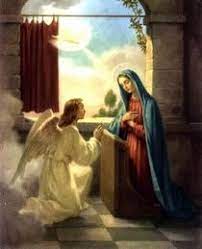
 As mentioned in Book II, according to the Gospel of Luke, Mary was not impregnated until she consented to be the handmaid of the L-rd. Thus, the Incarnation turned on the free will of a woman – fitting since Christianity sees Eve’s sin as heralding the downfall of man. Mary’s choice, then, turns history full circle: the mother of man sinned, the mother of the Divine atones. And given the Doctrine of the Immaculate Conception* which holds that Mary was born without the stain of Original Sin (the only human not a true daughter of Eve) she was ‘pure’ enough to carry the Savior.
It bears remembering that the Church views the Incarnation as a point of closure for the human race in other ways. If the sin in the Garden of Eden resulted from man wanting to become G-dlike (lusting after knowledge and all that brings), then G-d becoming man answers that human quest for Divineness in an interesting way. And, as Saint Bonaventure reminds us, the angels play as big a role in the Incarnation as the Fall: Mary consents to her destiny because of Gabriel’s persuasiveness just as Eve turned her face from G-d because of the serpent’s promises (the serpent commonly believed to be a fallen angel). Bonaventure sees the angels’ role in both events as consistent with Gregory the Great’s words: ‘evils are healed by their opposites’. Thus, Gabriel’s actions atone for those of the serpent. In summary, the Incarnation only comes to pass when THREE things happen: G-d wills it; the angels, as intermediaries, do their part; and, a human, exercising her free will, consents.
One can see in the Annunciation story the paradigm for Divine intervention in our world and a clear answer to those who wonder ‘how can bad things happen to good people?’ The angels can guide and persuade only and G-d is bound (self bound, of course) by the free will of humans. We decide if good or evil will reign here on earth; we decide which angels to heed.
* formally recognized by the Vatican only 150 years ago, but as the Pope exercised his infallibility, there’s no going back despite Vatican II’s anti-Marian measures.
 Ariella Abruzzi Novelist