
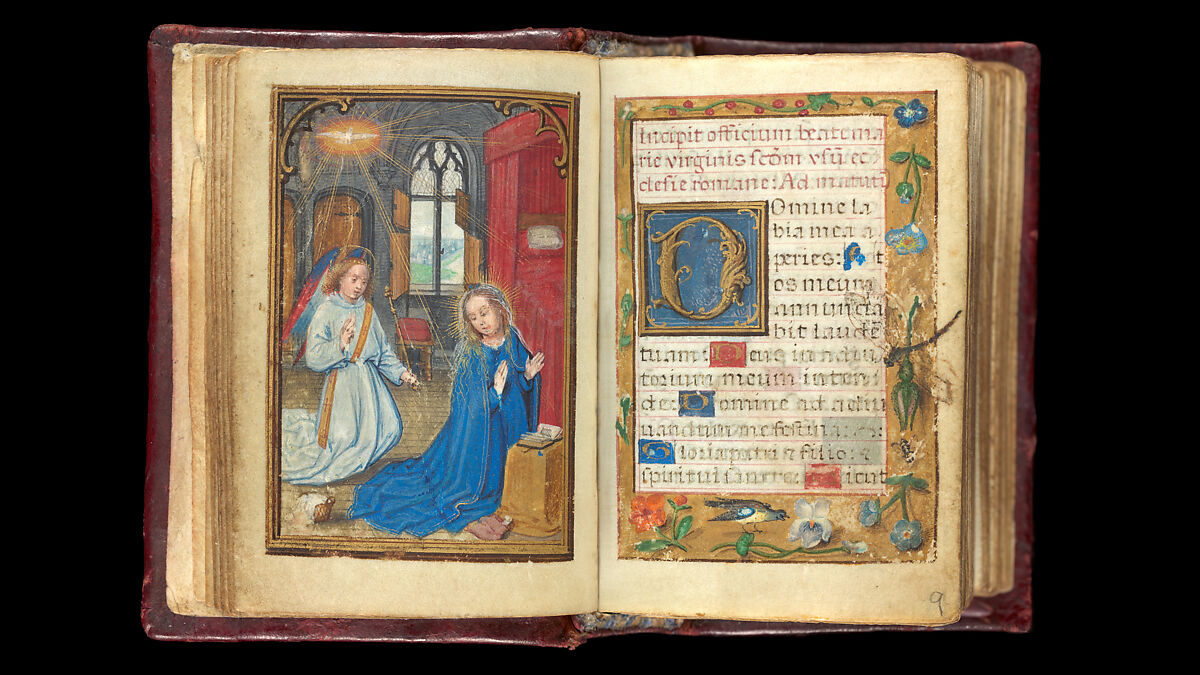
A Medieval Book of Hours
As described in the novel, a medieval Book of Hours contained a section entitled the Office of the Dead – no, that’s not a department in Kafka’s bureaucratic hell, but a collection of prayers that were recited by devout Catholics at home during the 8 ‘offices’ of the day. Praying for the souls of the dead was considered a sacred duty in the Middle Ages, and is today for the Mass includes intercessory prayers. Yet many Catholics think that the concept of Purgatory (from the Latin verb purgare, to cleanse) is outmoded. Not true. It is as much a part of Catholic doctrine as it always was. In the interests of time, and because a dear friend does not believe that this is still so, I have extracted below the relevant sections from The Catechism of the Catholic Church/Faith (1992). * Note that Purgatory is for those who die guilty of unrepented, venal sins – the theory being that one can’t enter the presence of G-d until such sins are purged through the cleansing fires of purgation and with the intercession of the living.
Article 12, Section III. THE FINAL PURIFICATION, OR PURGATORY
No. 1030 All who die in God’s grace and friendship, but still imperfectly purified, are indeed assured of their eternal salvation; but after death they undergo purification, so as to achieve the holiness necessary to enter the joy of heaven.
No. 1031 The Church gives the name Purgatory to this final purification of the elect, which is entirely different from the punishment of the damned.606 The Church formulated her doctrine of faith on Purgatory especially at the Councils of Florence and Trent. The tradition of the Church, by reference to certain texts of Scripture, speaks of a cleansing fire:607
- As for certain lesser faults, we must believe that, before the Final Judgment, there is a purifying fire. He who is truth says that whoever utters blasphemy against the Holy Spirit will be pardoned neither in this age nor in the age to come. From this sentence we understand that certain offenses can be forgiven in this age, but certain others in the age to come.608
No. 1032 This teaching is also based on the practice of prayer for the dead, already mentioned in Sacred Scripture: “Therefore [Judas Maccabeus] made atonement for the dead, that they might be delivered from their sin.” From the beginning the Church has honored the memory of the dead and offered prayers in suffrage for them, above all the Eucharistic sacrifice, so that, thus purified, they may attain the beatific vision of God. The Church also commends almsgiving, indulgences, and works of penance undertaken on behalf of the dead:
- Let us help and commemorate them. If Job’s sons were purified by their father’s sacrifice, why would we doubt that our offerings for the dead bring them some consolation? Let us not hesitate to help those who have died and to offer our prayers for them.
- ————–
It is beyond the scope of this blog, and beyond my meager understanding of theology, to fully explain the concept of Purgatory. Suffice it to say that Purgatory is a sort of celestial waiting room for those who died in grace to the extent that they are assured salvation. It is also a place for second chances where venial sins can be effectively ‘worked off’. What form does the punishment/purgation take? Who knows! Augustine had ideas, as did St. Jerome, St. Gregory and others – all of them fascinating (at least to me). I think a lot of the negative press about the concept of Purgatory misses a crucial point: in advancing the notion that there was a connection between the living and the dead, the Church made the living part of their loved one’s redemption. That’s a powerful and beautiful thought – through prayer and good works in this life, you/we can affect the future of those who’ve passed over, for Purgatory isn’t a place where one works off the wages of sin ALONE. Loved ones in the living world can help. Why is this important? Because you’ll only have loved ones to intercede for you if you lived a worthy life – one of kindness, humility, love, and generosity. So, it’s a carrot of sorts – one meant to encourage us to live well and leave behind people who will care enough to pray for our souls. Powerful stuff that. And it gives the living, who often feel helpless and alone after the death of a loved one, something to DO – a way to be useful to those who’ve passed over. Let’s put aside the abuses resulting from the sale of Medieval indulgences and all that and simply appreciate that, when remembering the dead becomes more than telling stories, one is reminded not only that the dead are still very much a part of our lives, but that we are still a part of theirs.
* The CCC is a codification of official Catholic doctrine promulgated by Pope John Paul II in 1992 (30 years after Vatican II). It sets out the Church’s official position on a variety of matters. It is available (in English) on the Vatican’s website and many other places. Purgatory as an essential doctrine was recognized by the Council of Trent (among other bodies) where the concept of the living helping the dead through the intercession of prayer was recognized.
 Ariella Abruzzi Novelist