
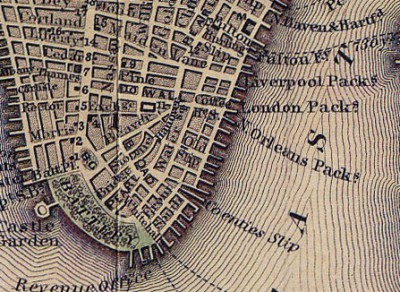
 Lower Manhattan docks as they appeared in the 1840’s. Note where the Liverpool (and undoubtedly Galway, Dublin and Cork) packet ships would have docked. Of course, the Brooklyn Bridge hadn’t yet been built.
Over half a million Famine survivors entered the U.S. through the South Street Seaport. Much has been written of what new immigrants experienced after 1-2 months at sea when land was finally sighted. They would have sailed around Long Island, seeing green fields and much else that might have been familiar to those raised on farms. After a week of this, the Manhattan skyline would have come into view. Although there were few buildings over three stories at that time, Manhattan would have been an awesome sight. What I’d like to draw the reader’s attention to is one building that would have dominated the lower Manhattan skyline as it was only 7 blocks from the pier: Trinity Church.

Spires of the Anglican Trinity Church (surrounded by green) visible just north-west of Manhattan’s South Street Seaport (1850).
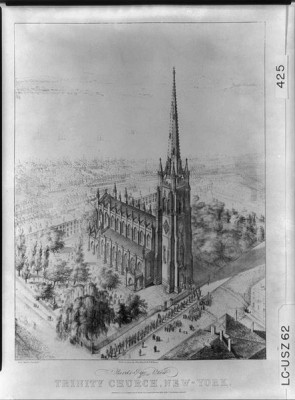 Pictured here in 1846, Trinity Church was built in Lower Manhattan in 1697. A royal charter for its construction was given by England’s King William III – the same ‘King Billy’ who had defeated the Catholic (Jacobite) King James during their game-changing battle in Ireland less than a decade earlier. It was the defeat of James, and his subsequent flight to France with many Catholic Irish nobles, that was to prove such a watershed in Irish/British history. Once William of Orange and his queen secured the British (and Scottish) thrones, the penal laws targeting Irish Catholics for discrimination followed in short order.
Take a moment to consider how Famine immigrants felt when they gazed up at Trinity’s spires – at the Anglican church that dominated lower Manhattan much as the Anglican church and her Crown supporters had so dominated their lives. They couldn’t know how their exodus to freedom would some day reshape Manhattan; they couldn’t know that within a generation they’d be pulled into a civil war not their own; they couldn’t know that within five generations they’d help pull Britain back from the brink of destruction – twice. No, they didn’t know all that. But they knew enough to make their way past Trinity Church to Mulberry Street, finding there Saint Patrick’s Old Cathedral (dedicated in 1815). A more modest building than Trinity, it was the seat of the New York Archdiocese until the consecration of the ‘new’ Saint Patrick’s Cathedral on Fifth Avenue and was the parish church for the neighborhood’s Irish immigrants.
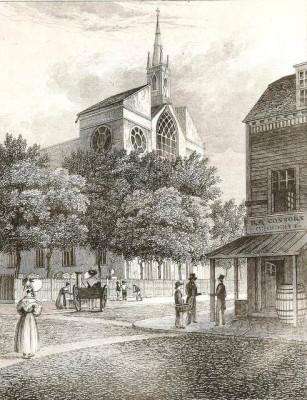 Saint Patrick’s Old Cathedral on Mulberry Street in Manhattan (about 1815).
 Ariella Abruzzi Novelist